
Choosing Nursing Beds for a Care Home: What Facility Buyers Should Ask
A care home buys beds differently from a family. A family buys one bed for one person; a facility buys a fleet, and every weakness in the bed is multiplied across every resident and every shift. Before comparing prices, compare the work: how many toileting rounds a day each bed removes from the staff rota, how turning works when one carer is alone on a night shift, how bathing works without a transfer, and what the bed needs from the building — a drain connection, a power supply, floor space. Then ask for the evidence: report numbers, standards and results, quoted exactly. Send the supplier your country, quantity, intended use and expected time, and judge the answer on the work it removes, not the features on the list.
Start with the resident, not the catalogue
Every nursing bed brochure looks the same: a smiling resident, a list of features, a promise. The way to choose is to start from the other end — from the resident who will spend most of the day in the bed, and from the carer who will work around it.
In a care home, the residents who need a nursing bed are usually the ones who cannot move on their own: paralysed, incontinent, recovering from a stroke or surgery, or at the end of life. They need the same things a home-care patient needs — sitting up, turning, toileting, cleaning, bathing — but the care is delivered by staff on shifts, to many residents, day after day. A bed that saves a few minutes per resident per day is not a small saving when there are many residents. It is the difference between a rota that works and one that does not.
Count the toileting rounds
Incontinence care is the largest single workload in most care homes, and it is the first thing to count. Ask: how many toileting rounds does each resident need per day, and how many staff minutes does each round take — lifting, bedpan, cleaning, linen change?
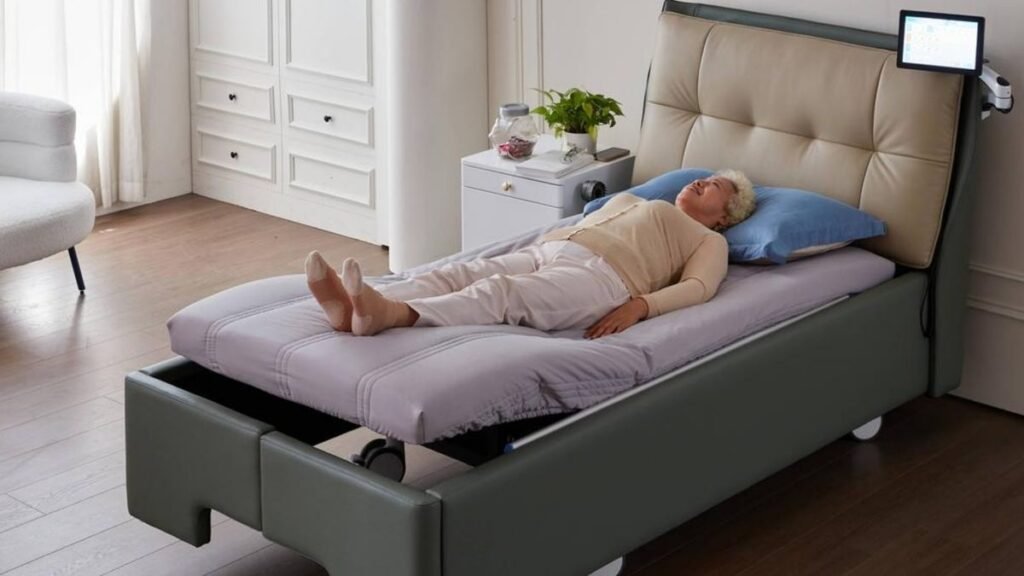
On the CH-ENB-01, toileting runs in the bed: 24-hour automatic monitoring detects use, the bedpan door opens in 1 second, 6 wide-angle nozzles clean 360°, waste is crushed and discharged into the sewer, and the body is blow-dried. No bedpan is used and waste is never handled. Water temperature, air temperature and cleaning time can be set to the user’s needs from the control panel, which also has a child lock and a self-check screen.
That changes the staffing question. Every toileting round that runs automatically is staff time freed for feeding, turning, conversation and observation — the parts of care that cannot be automated. When comparing beds, count the rounds per resident per day and ask what each round costs in staff minutes. That is the honest way to compare a bedpan routine with an automatic system, and it is a question worth putting to any supplier, including us.
Turning and pressure care on a night shift
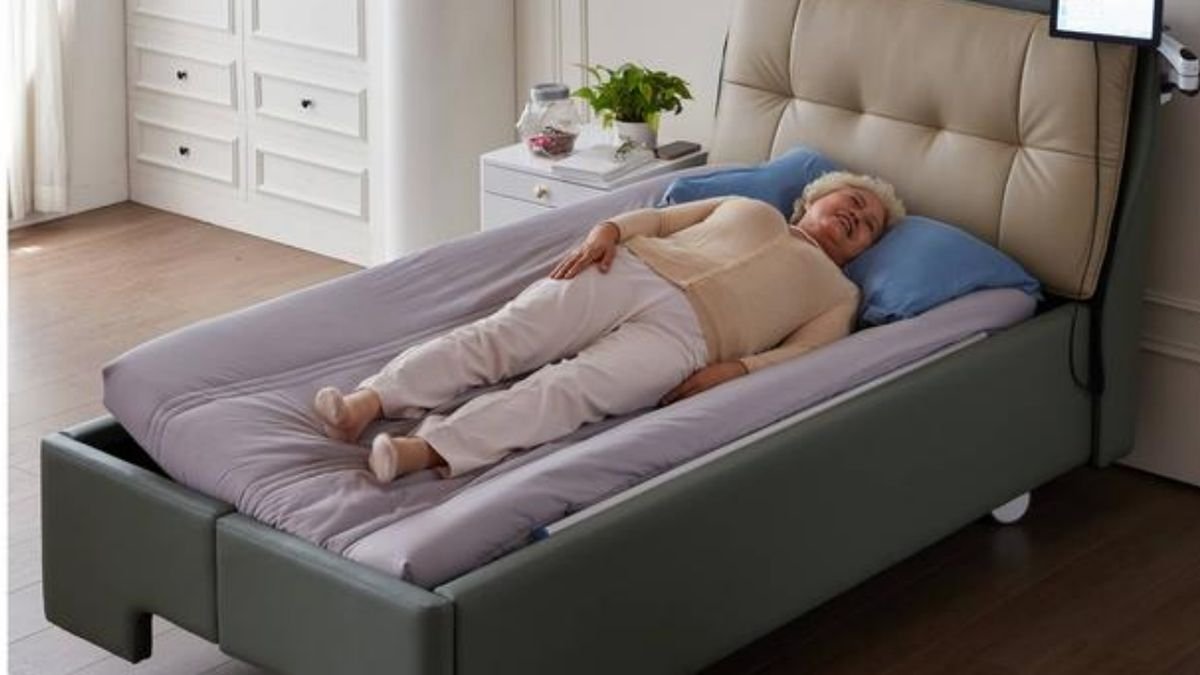
Turning is the second workload to count. A resident who cannot move has to be turned regularly to protect the skin, and on a night shift there may be one carer for a whole corridor. Turning by hand, resident after resident, is the heaviest work on the rota and the first thing to slip when the shift is short-staffed.
The CH-ENB-01 turns left and right, manually or automatically, and its automatic turning and wave massage air cushion supports pressure ulcer prevention. The backrest adjusts from 0 to 85°, the leg rest adjusts, and one button brings the user to a sitting position. Staff still check the skin and set the routine — the bed does not decide the care plan. But the lifting part of the turn is no longer a purely manual job, which is what makes the rota survivable on a thin night shift.
Bathing without a transfer
Bathing is the third workload, and the one most facilities get wrong by ignoring it. Moving a bedridden resident to a bathroom is a two-person lift and a transfer risk. When bathing is hard, it happens rarely, and the resident’s skin and dignity both suffer.
With the CH-ENB-01, one person can bathe the user in bed with the included inflatable bath tub and handheld shower, and bathing wastewater discharges into the sewer automatically. The tub is included as standard. Graphene heating, a shifting machine and a dining table board are optional accessories, not included by default — ask which accessories are included before you compare one supplier’s bed with another’s, because a bed that looks cheaper with no accessories is not the same bed.
What the building has to provide
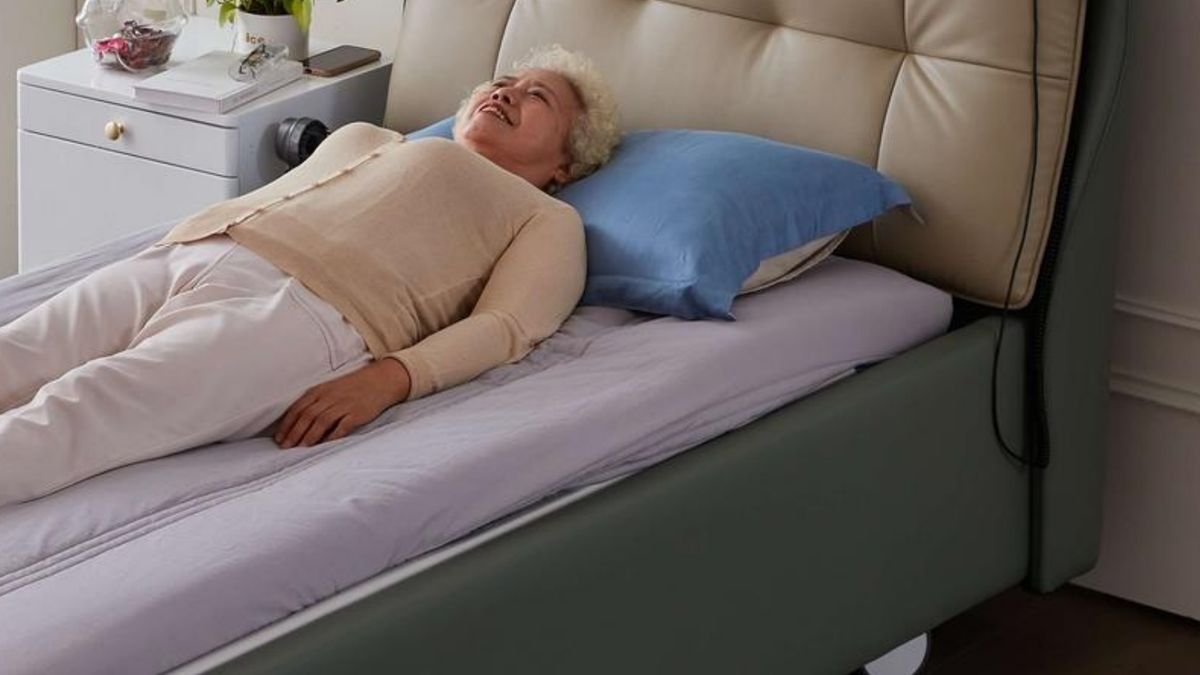
A smart nursing bed is not furniture you can put anywhere. Before ordering a fleet, check what each room has to provide:
— A drain / sewer connection. The bed must be connected to a drain / sewer pipe, because waste and bathing water are discharged into the sewer. There is no fixed requirement for drain distance or pipe size; the final placement is checked at installation. But the drain point has to exist — a bedroom with no drain nearby cannot use this kind of bed, and that is better discovered before ordering than after delivery.
— A power supply: 220–240V~, 50Hz, 950W per bed, for indoor use only.
— Floor space: the bed is 230 × 110 cm overall and 58 cm high, and the bedside cabinet is 47 × 47 cm and 63 cm high — plus working space for staff on both sides.
— The route in: doorways, corridors and turns from the entrance to the room.
Walk one room with a tape measure before ordering ten beds. The room will tell you what the brochure cannot.
Ask for the evidence, in the report’s own words
Any supplier can say a bed is safe. A care home buyer should ask for the documents, and read them:
— Electrical safety: report STE24011004S, EN IEC 60335-1:2023+A11:2023 and EN 62233:2008, result: complied. Note the protection rating IPX0 — the bed is not waterproof and must be kept dry.
— Electromagnetic compatibility: report STE24011003E, emission Class B, overall pass.
— Materials: wood slats formaldehyde 0.2 mg/L, pass (CKJC2401071702-1); fabric formaldehyde not detected, Class B, 24 carcinogenic aromatic amine dyes not detected (CKJC2401071702-2); sponge formaldehyde not detected, Class C (CKJC2401071702-3).
— Whole-bed furniture test: 16 tested items met the testing reference, formaldehyde 0.02 mg/m³, TVOC 0.047 mg/m³ (SQ2306722; English version of Chinese SQ2305655, Chinese version prevails).
— Biocompatibility: report WT23080949 tested only two skin-contact parts — urine baffle (silicone, cytotoxicity grade 1) and toilet seat cushion (PU, grade 2) — for batch 202309001 only, with no overall pass verdict.
— UDEM attestations M.2024.206.C95586 (EMC+LVD) and M.2024.206.C95585 (GPSD), valid to 2029-01-14, are attestations of conformity, not EU notified-body CE certificates.
If a supplier’s safety claim cannot be traced to a report number, a standard and a result, treat it as a claim, not a fact. And if a claim is quoted with a number that does not match the report — 25 items where the report says 16, Class B where the report says Class C — that tells you something about the supplier too.
What to send in an enquiry
A good enquiry saves a round of emails. Send the supplier: your country, the quantity, the intended use (care home, hospital, distributor), and the expected time. Add the room facts that decide whether the bed can work: where the drain points are, the power supply available, and the room sizes. A supplier who asks about your drain points before quoting is a supplier who has installed beds before; one who quotes first and asks later is not.
Price, minimum order quantity, delivery time and warranty are confirmed on enquiry. Do not compare suppliers on a headline price alone — compare the bed, the included accessories, the installation check, and the evidence, all together.
A short checklist for the decision
| Question | What a good answer looks like |
|---|---|
| How many toileting rounds per resident per day does the bed remove? | A number in staff minutes, not adjectives |
| How does turning work on a night shift? | Automatic turning, not only manual |
| How is bathing done? | In bed, by one person, tub included as standard |
| What does the room need? | Drain connection, 220–240V~ supply, 230 × 110 cm plus working space |
| What evidence is on file? | Report numbers, standards and results, quoted exactly |
| What is included, and what is optional? | Tub standard; graphene heating, shifting machine, dining table board optional |
FAQ
How do we compare beds for a facility?
Count the work, not the features: toileting rounds per resident per day, turning on a night shift, bathing without a transfer, and what the building must provide. Then compare the evidence behind each bed.
What does each room need for this bed?
A drain / sewer connection, a 220–240V~, 50Hz power supply, and room for a 230 × 110 cm bed plus the 47 × 47 cm cabinet and working space. The final placement is checked at installation.
Is the bed safe for residents who cannot move?
The evidence on file is listed in this article: electrical safety report STE24011004S (complied), EMC report STE24011003E (Class B, overall pass), materials reports CKJC2401071702-1/-2/-3, whole-bed furniture test SQ2306722 (16 items), and biocompatibility report WT23080949 (two skin-contact parts only). The bed is IPX0, not waterproof, and for indoor use only.
What is included as standard, and what is optional?
The inflatable bath tub is included as standard. Graphene heating, the shifting machine and the dining table board are optional accessories.
What should our enquiry include?
Your country, quantity, intended use (care home, hospital or distributor), expected time, and the room facts — drain points, power supply and room sizes.
See the full model, specifications and test reports on the product page. For a quote, please email admin@chinahospitalbed.com with your country, quantity and intended use.